
Six things that have happened in H1 2026, three things to expect in H2.
It is June 2026. The first half of the year has rearranged enterprise AI in ways that the trend pieces written in January did not see coming. Agents have moved from pilots to production, but unevenly. A protocol almost nobody had heard of eighteen months ago has become the integration standard for the AI economy. The data foundation conversation has finally arrived in the boardroom — not because the CDO finally got the agenda item approved, but because SAP paid a reported multi-billion-dollar sum to acquire a master data company in March. AI cost discipline, which barely existed as a concept twenty-four months ago, is now operated by ninety-eight percent of FinOps practices. Regulation has arrived, but selectively — and on a calendar enterprises are now on the clock for.
This piece is a mid-year audit. Six things that actually changed in the first half of 2026, with the data to back them. And three things to expect in the back half, with the bets that follow from them.
1. AI agents crossed into production, but unevenly
The single biggest change in H1 2026 is that AI agents stopped being a pilot category. Gartner forecasts that forty percent of enterprise applications will embed task-specific AI agents by the end of 2026, up from less than five percent in 2025. Eighty percent of enterprise applications shipped or updated in Q1 2026 already embed at least one AI agent. The market analytics for agentic AI converged on a 2026 size of roughly twelve billion dollars with a 44-46% compound annual growth rate through 2030. The category is no longer emerging. It is mainstream.
But "mainstream" is uneven, and the unevenness is the story.
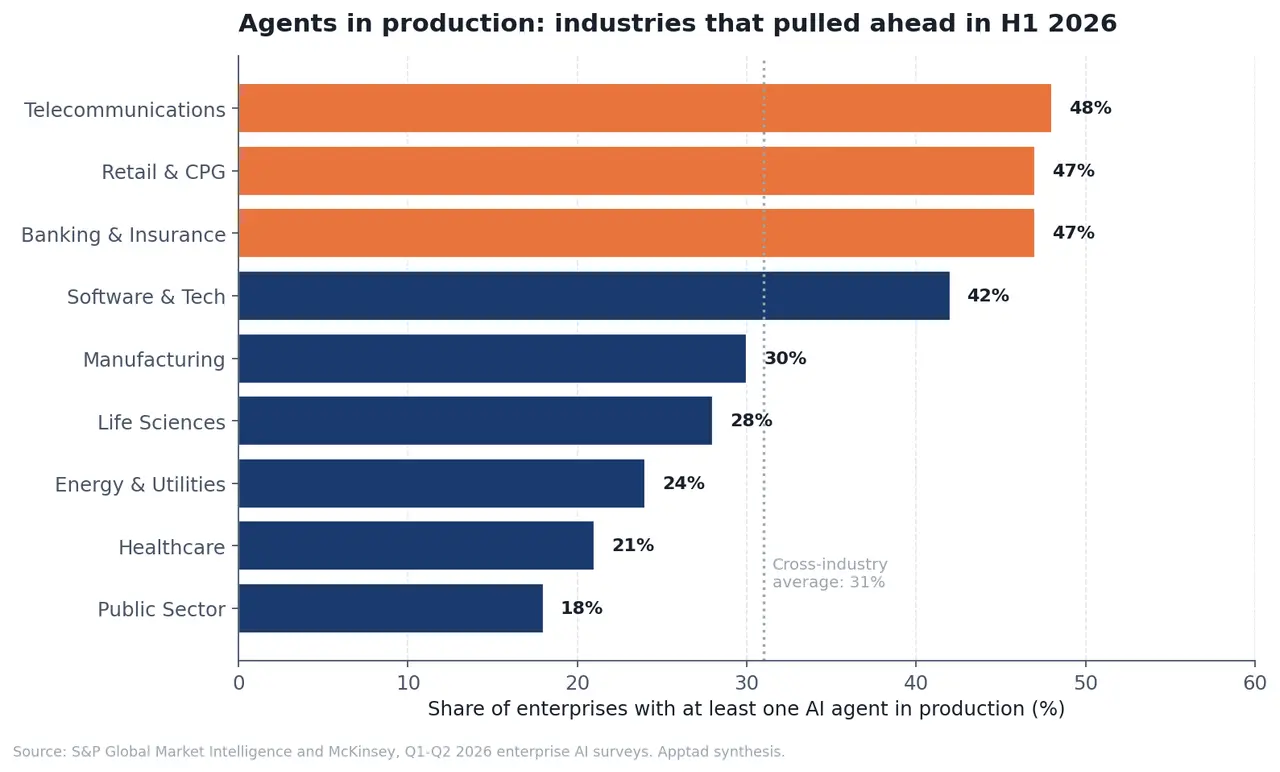
Cross-industry, thirty-one percent of enterprises now have at least one AI agent in production — the kind of number that would have read as fantasy two years ago. The leaders are telecommunications at forty-eight percent, retail and CPG at forty-seven percent, and banking and insurance also at forty-seven percent. Software and tech are at forty-two. Manufacturing is at thirty. The trailing industries — healthcare at twenty-one and public sector at eighteen — are not behind because they are slow or unsophisticated. They are behind because their regulatory perimeter is harder to defend on a non-deterministic system, and because the data foundation work that has to happen before an agent ships in production is more expensive in their estates.
The leaders pulled ahead by industrialising what Apptad and similar partners have been arguing for two years: agents do not ship in production until the data, identity, and governance layer underneath them does. The trailing industries are now doing the work the leaders did in 2024. They will close most of the gap by mid-2027.
The caution worth naming, because it will be the H2 2026 headline: Gartner predicts forty percent of agentic AI projects will be canceled by 2027 due to runaway costs, unclear ROI, and governance failures. Only twenty-five percent of AI initiatives currently deliver expected ROI. Only sixteen percent reach enterprise-wide scale. The agent boom is real, and the agent shakeout is starting.
2. The Model Context Protocol became the integration standard nobody saw coming
In November 2024, Anthropic published a specification for how AI systems should connect to external tools and data sources. It was small, it was open, it was technically interesting, and almost nobody outside the AI-infrastructure community thought it would matter at scale. Eighteen months later, the Model Context Protocol has become the de facto integration standard for the entire enterprise AI economy.
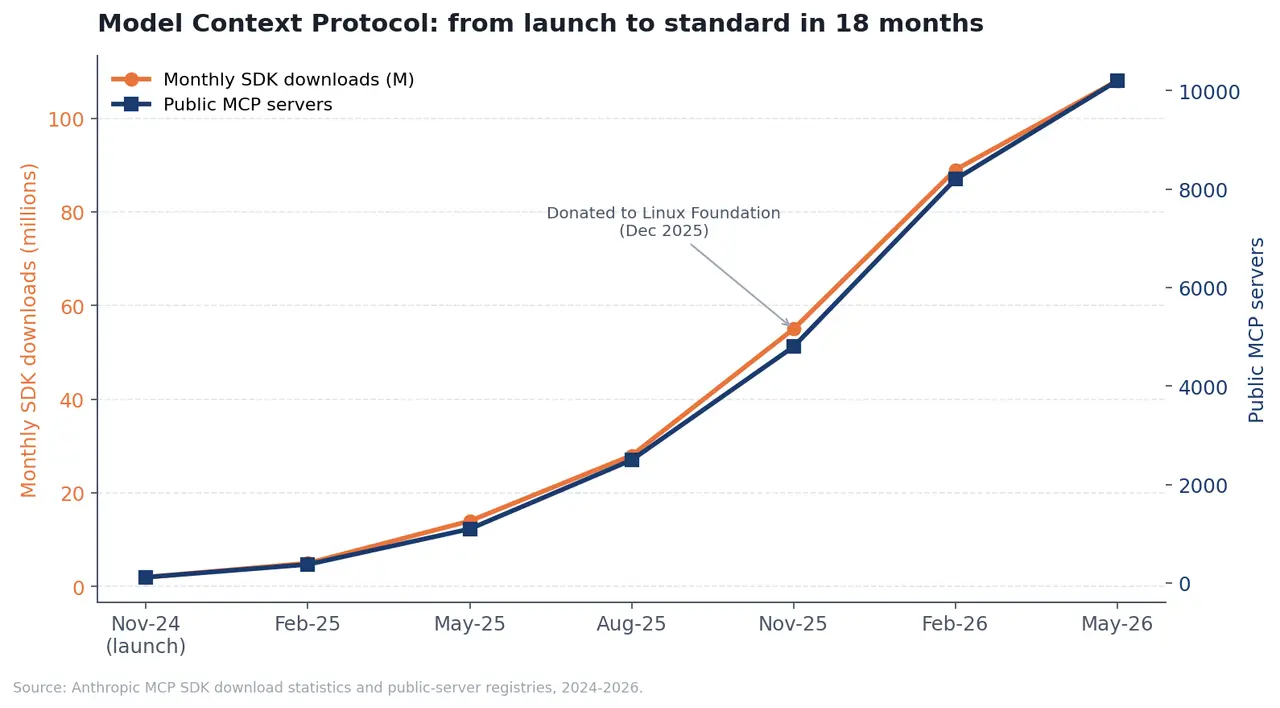
The numbers are unusual even by 2024-2026 enterprise software standards. MCP's TypeScript and Python SDKs reached ninety-seven million monthly downloads in March 2026, up from approximately two million at launch — a growth rate of roughly four thousand seven hundred and fifty percent in sixteen months. The public server ecosystem has crossed nine thousand four hundred entries, with private and enterprise-internal servers conservatively estimated at three to four times that number. Stacklok's 2026 software report shows forty-one percent of surveyed software organisations in limited or broad production with MCP servers.
What sealed the standard was the December 2025 donation of MCP from Anthropic to the Agentic AI Foundation, a directed fund under the Linux Foundation co-founded by Anthropic, Block, and OpenAI. With that move, MCP stopped being a vendor protocol and became vendor-neutral infrastructure. ChatGPT, Cursor, Gemini, Microsoft Copilot, Visual Studio Code, and most major AI products now consume MCP servers natively. The MDM platforms — Reltio AgentFlow, Informatica CLAIRE Agents, and STIBO's parallel work — are exposing their capabilities as MCP endpoints. Salesforce, Snowflake, and the major cloud providers are doing the same.
The procurement consequence is direct: as of H1 2026, a vendor's MCP posture is now part of the buying conversation. "Does your platform expose its capabilities via MCP?" has joined "Does it run in our cloud?" as a default question. Vendors that answer no are explaining themselves. Vendors that answer yes are being slotted into agentic stacks that nobody had on the architecture diagram a year ago.
3. AI FinOps emerged as a discipline almost overnight
The cost story of enterprise AI shifted decisively in H1 2026. The State of FinOps 2026 report shows ninety-eight percent of FinOps practices now manage AI spend — up from sixty-three percent in 2025 and thirty-one percent in 2024. In two years, AI cost management went from an edge concern to universal practice.
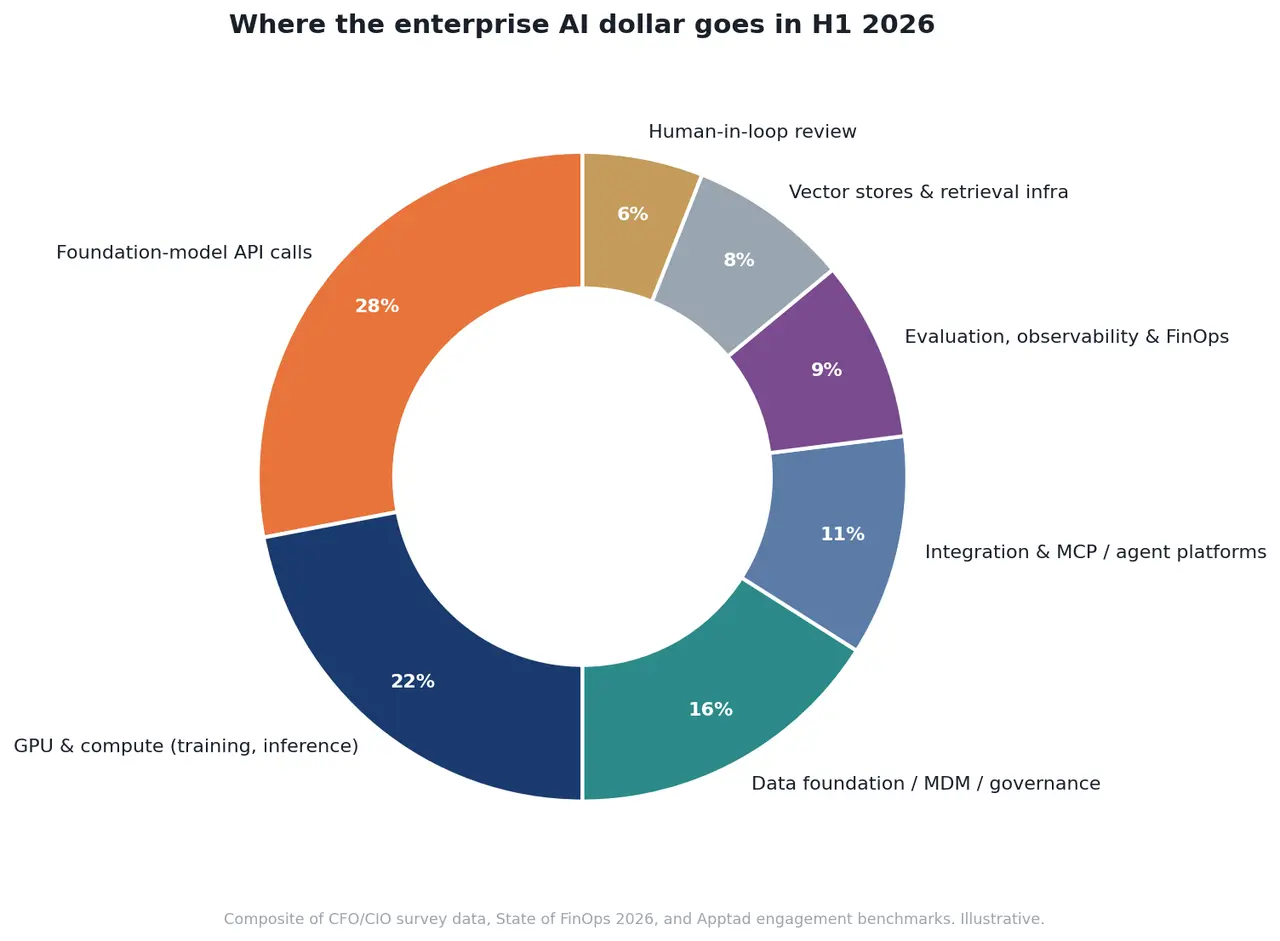
The composition is itself worth pausing on. Foundation-model API spend is the largest single category at roughly twenty-eight percent of the AI budget. GPU and compute costs, including both training and inference, account for another twenty-two percent. The data foundation — MDM, governance, identity resolution — has emerged as the third-largest category at about sixteen percent, which is a structural change in how CFOs now think about AI investment. Integration and MCP/agent-platform spend is at eleven percent. Evaluation, observability, and AI FinOps tooling at nine percent. Vector stores and retrieval infrastructure at eight. Human-in-loop review at six.
The categories that surprised CFOs in H1 2026 are the small ones. Human-in-loop review, dismissed as a temporary cost on day one, has become a structural cost line that the agent shakeout will only enlarge. AI FinOps tooling, which barely existed eighteen months ago, has become a procurement category in its own right. And the data-foundation share, at sixteen percent, is forcing a conversation enterprises had been deferring: MDM and governance are not the slow-moving cost line they were in 2022; they are now a meaningful share of the AI program's economics.
The model deprecation crisis is the next item on the FinOps agenda. Vendors are deprecating model versions on shorter cycles than enterprises designed their agents for, and the cost of re-evaluating, re-grounding, and re-deploying against a new model is not yet line-itemed in most 2026 AI budgets. It will be by Q4.
4. The data foundation conversation entered the boardroom
The slowest-moving of the six shifts is the one that will turn out to be most consequential. For most of the last decade, master data management and the broader data-foundation conversation lived two organisational layers below the CEO. In H1 2026, that changed.
In March, SAP announced its acquisition of Reltio, the cloud-native MDM platform that Gartner had named a Leader in its 2026 MDM Magic Quadrant only weeks earlier. The strategic logic was explicit in SAP's announcement: make SAP and non-SAP data AI-ready. The signal was unmissable. The dominant enterprise application vendor had decided that the AI value it could capture inside its own customer base depended on owning the master-data layer the AI would reason over.
Marriott's "agentic mesh" announcement in February — a billion-dollar-plus capex commitment, with more than a third directed at digital and technology transformation including PMS replatforming, CRS rebuild, and the construction of a shared intelligence layer for AI agents — made the same point from the customer side. The agentic mesh is, on inspection, a master-data and entity-resolution foundation with a new label. Marriott named it for what it does for AI rather than what it does for data management, and the naming is itself the story.
The downstream consequence has been faster than expected. CDO-level conversations that were stuck in vendor-evaluation purgatory through 2024-2025 are now being escalated to CEO and board sponsorship. The business case has changed from "improve data quality" to "unblock the AI roadmap," and the latter business case clears governance committees that the former never could.
5. Conversational interfaces started eating dashboards
The boundary between AI and the rest of the application stack moved this year. For thirty years, the dominant interface between enterprise data and the human decision-maker was the dashboard. That interface is now collapsing into agents that answer questions directly, monitor metrics autonomously, and act on them.
Hilton's AI Planner shipped in March 2026 — a conversational concierge in beta on hilton.com. Hyatt embedded a ChatGPT app and added intent-based search on Hyatt.com. Accor put its loyalty application directly inside ChatGPT in more than twenty languages. Marriott committed to deploying natural-language search across Marriott.com and the Bonvoy app in H1 2026. The pattern is now visible across hospitality, retail, financial services, and increasingly B2B SaaS.
The point is not that dashboards are dying. The point is that the dashboard's role is shifting from rendering pixels for humans to feeding context to agents. The semantic layer that sits between the data warehouse and the analytics tool — the place where business definitions live, where metrics are agreed, where lineage is tracked — has become the most strategically valuable layer in the analytics stack, because it is what the agent reads from to answer the question the human used to ask the dashboard.
The analytics function that adapts to this first will win. The ones that defend the dashboard as the deliverable will be doing maintenance work in eighteen months.
6. Regulation arrived, on a calendar enterprises are now on the clock for
The compliance perimeter for enterprise AI tightened in H1 2026, and the calendar from here is concrete.
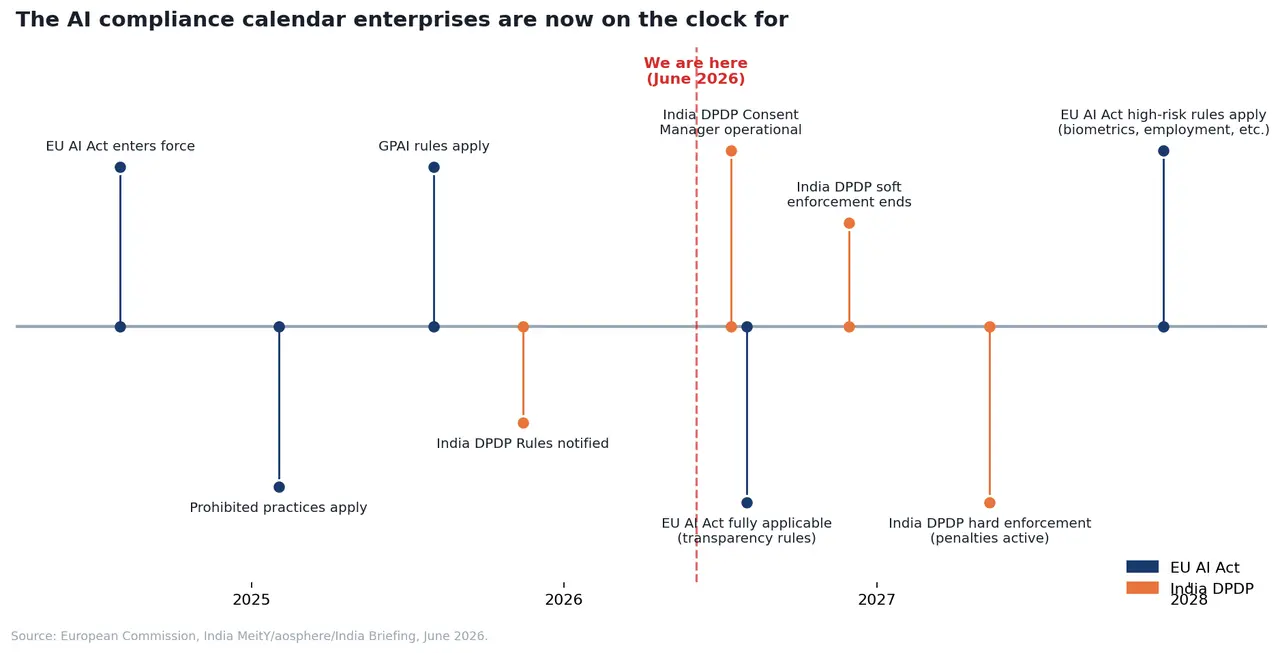
The EU AI Act, which entered force in August 2024, becomes fully applicable on 2 August 2026 with the transparency obligations for general-purpose AI and the conformity-assessment requirements for high-risk systems coming into application. The high-risk categories themselves — biometrics, critical infrastructure, education, employment, migration, asylum, border control — get their full enforcement window on 2 December 2027. The clock is now meaningfully running for enterprises whose AI use cases touch any of those domains, and the conformity-assessment work has to be done before the date, not after.
India's Digital Personal Data Protection Act and the DPDP Rules notified in 2025 are in a phased rollout that the Indian government has described as "soft enforcement" through 2026, transitioning to "hard enforcement" on 13-14 May 2027. The Consent Manager framework — interoperable platforms through which data principals can manage, review, or withdraw consent across multiple digital services — is expected to become operational between June and August 2026. November 2026 is widely expected to signify the end of the initial implementation period, after which the Data Protection Board of India transitions from awareness-building to active enforcement, with penalties up to ₹2.5 billion (about US$26 million) for major violations.
Enterprises operating in both jurisdictions — which is most large enterprises — are now navigating a compliance calendar that requires conformity-assessment documentation in August 2026, consent-manager integration through mid-to-late 2026, and a hard penalty regime starting May 2027. That is not abstract policy. That is a project plan.
What to expect in H2 2026
Three calls for the back half of the year, each with implications for how enterprises should sequence their work.
The first wave of agentic AI cancellations
Gartner's prediction that forty percent of agentic AI projects will be canceled by 2027 will start showing up in Q3 and Q4 2026 budget reviews. The cancellations will not be evenly distributed. They will cluster in two patterns: agents whose business case was built on assumed cost economics that did not survive contact with model deprecation and token-spend growth, and agents whose data foundation underneath them was never robust enough to support production behaviour. The enterprises that have done the FinOps and data-foundation work in H1 will keep their agents in production. The ones that did not will pull them.
The action for CIOs and CDOs is to pre-empt the cancellation conversation by running an honest internal audit before the budget review forces it. The agents that should be killed should be killed deliberately, with the data and infrastructure preserved for the next generation of attempts, rather than canceled in a budget panic.
MCP becomes a procurement question in every vendor RFP
By Q4 2026, every meaningful enterprise software RFP — for ERP, CRM, MDM, data platforms, analytics, integration, and increasingly even infrastructure — will include MCP-related questions as a default. Vendors that have not exposed their capabilities as MCP servers will be at a structural disadvantage. Vendors that have done so cleanly will be slotted into agentic architectures that the buyer is now actively designing for.
The action for procurement and architecture teams is to add MCP posture to the standard vendor scorecard now, before the next major procurement cycle. The action for vendors is to ship credible MCP support in H2 if they have not already.
The AI sovereignty conversation intensifies
The combination of the EU AI Act becoming fully applicable, India DPDP entering its consent-manager phase, and the broader geopolitical environment around model training data, compute location, and inference location means that "where does this model run and what data does it touch?" will become a board-level question by year-end. Enterprises that have been comfortable consuming AI through API calls to vendor-hosted models will face new pressure to articulate their sovereignty posture explicitly.
The action is not necessarily to repatriate inference or train sovereign models. The action is to be able to answer the question coherently, with the data flows, model versions, training-data composition, and compliance chain documented in a way that survives an external review. Enterprises that cannot will find the answer chosen for them by a regulator, a customer, or a sales-cycle blocker.
The reframing
Enterprise AI in 2026 is no longer about whether to adopt. It is about how to industrialise. The vocabulary has changed — agentic, MCP, sovereignty, FinOps, compliance calendar — but the discipline underneath is recognisable: build the data foundation, govern the operating model, manage the unit economics, and earn the right to scale.
The enterprises pulling ahead are doing all four. The enterprises falling behind are still treating AI as a procurement question rather than an industrial one.
Apptad partners with CIOs, CDOs, and AI program leaders to industrialise enterprise AI — the data foundation, the agent operating model, the FinOps discipline, and the compliance posture — across Reltio AgentFlow, Informatica CLAIRE Agents and CLAIRE GPT, STIBO, Salesforce, Databricks, Snowflake, Microsoft Fabric, and the surrounding ecosystem. If your H1 2026 made it clear that the AI roadmap is moving faster than the foundation underneath it, H2 is the right time to close the gap. That is the conversation worth having.